
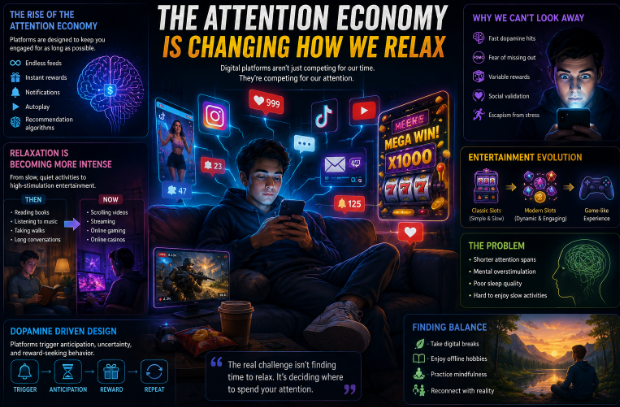

The way people relax has changed dramatically over the past decade. Activities that once felt slow, quiet, and calming are now being replaced by faster, more stimulating forms of entertainment designed to capture attention instantly. From endless scrolling on social media to short-form videos, competitive gaming, streaming culture, and modern online casinos, today’s digital world is built around one thing above all else: attention.
Even platforms connected to online entertainment, including situs slot, have evolved to fit this new environment where users constantly seek faster excitement, stronger stimulation, and more emotionally engaging experiences. The internet is no longer competing simply for people’s free time it is competing for every second of their focus.
The Rise of the Attention Economy
The term “attention economy” refers to a modern digital environment where human attention has become one of the most valuable resources in the world. Companies no longer compete only through products or services. Instead, they compete to keep users engaged for as long as possible.
This is why so many online platforms are designed around:
- endless feeds,
- autoplay systems,
- notifications,
- instant rewards,
- recommendation algorithms,
- and highly stimulating visuals.
The longer people stay engaged, the more profitable the platform becomes.
Social media applications perfected this model first. Platforms like TikTok, Instagram Reels, and YouTube Shorts transformed content consumption into a nonstop cycle of fast dopamine hits. Videos became shorter, louder, and more emotionally intense because quick stimulation keeps users watching.
Eventually, this same philosophy spread across nearly every form of digital entertainment.
Relaxation Is Becoming More Intense
In the past, relaxation often meant slowing down:
- reading books,
- listening to music,
- taking walks,
- or having long conversations.
Modern digital entertainment moves in the opposite direction. Today’s relaxation often involves high stimulation and constant interaction.
People now spend hours:
- scrolling through videos,
- watching livestreams,
- playing high-speed mobile games,
- browsing online casinos,
- or jumping rapidly between multiple apps at once.
Ironically, many forms of “relaxation” now leave people mentally overstimulated rather than calm.
This shift reflects how deeply the attention economy has influenced human behavior.
Why Digital Platforms Prioritize Stimulation
Modern platforms are carefully engineered to maintain engagement.
Developers use psychology, behavioral science, and algorithms to create systems that trigger emotional responses such as:
- excitement,
- anticipation,
- curiosity,
- urgency,
- and reward expectation.
This is visible across many industries.
Streaming platforms encourage binge-watching.
Social media platforms encourage endless scrolling.
Video games reward constant progression.
Modern online slots use flashing animations, multipliers, and rapid bonus mechanics to increase excitement levels.
Everything is optimized to reduce boredom and maximize stimulation.
As a result, users become increasingly accustomed to fast emotional feedback.
The Connection Between Entertainment and Dopamine
Dopamine plays a major role in modern entertainment systems. Contrary to popular belief, dopamine is not simply the “pleasure chemical.” It is strongly connected to motivation, anticipation, and reward-seeking behavior.
Many digital platforms exploit this by constantly creating moments of uncertainty and potential reward.
Examples include:
- social media likes,
- random notifications,
- loot boxes in games,
- surprise recommendations,
- and unpredictable casino mechanics.
The brain becomes conditioned to continuously seek the next moment of stimulation.
This is one reason why modern entertainment often feels difficult to stop consuming.
Online Gaming and Escapism
Another major factor behind the rise of the attention economy is digital escapism. Modern life is increasingly stressful:
- work pressure,
- financial anxiety,
- information overload,
- and nonstop connectivity.
As a result, many people use digital entertainment as a form of emotional escape.
Online gaming, livestreaming, and interactive entertainment offer temporary relief from daily stress. These experiences provide excitement, distraction, and immersion in ways traditional entertainment often cannot.
Modern online casino games especially reflect this trend. Many no longer resemble classic slot machines. Instead, they are designed more like high-intensity video games featuring:
- cinematic visuals,
- dynamic mechanics,
- massive multipliers,
- and nonstop action sequences.
The line between gaming and gambling continues to blur.
The Problem With Constant Stimulation
While the attention economy creates highly engaging entertainment, it also raises concerns.
Constant exposure to fast-paced digital stimulation may affect:
- attention spans,
- focus,
- patience,
- sleep quality,
- and emotional balance.
Many people now struggle to enjoy slower activities because their brains have adapted to rapid stimulation cycles.
Even moments of silence or boredom can feel uncomfortable after long exposure to algorithm-driven entertainment environments.
This does not necessarily mean digital entertainment is harmful by default. However, it does show how strongly technology is shaping modern habits and emotional behavior.
The Future of Relaxation
As artificial intelligence, personalization algorithms, and immersive technologies continue evolving, entertainment will likely become even more tailored to individual psychology.
Future digital platforms may offer:
- hyper-personalized content feeds,
- adaptive gaming systems,
- AI-generated entertainment,
- virtual reality social spaces,
- and increasingly immersive online experiences.
The competition for human attention will only become more intense.
At the same time, many people are beginning to rediscover slower forms of relaxation:
- reading,
- meditation,
- nature travel,
- journaling,
- and offline hobbies.
This suggests that while the attention economy continues to dominate digital culture, there is also growing awareness about the importance of balance.
Ultimately, the modern world is redefining what relaxation looks like. Entertainment is no longer designed simply to help people unwind — it is designed to keep them engaged, stimulated, and emotionally connected for as long as possible.